Readers Suggestions

I'm enjoying visiting as many of the '1000 Places to See Before You Die' as I can, but I'm aware there must be loads of other fantastic places to visit, that aren't in the book. Please make comments at the end of each posting with your recommendations!

Monday, 11 July 2011

198: Mougins, Provence

 Yes, Yes, Yes- a resounding tick for entry into the 1000 places to see before you die book!!
Had a very lovely three day stay using this little hillside town as the base to explore Cannes, Juan St Pins, Vence and Nice. The town consisted of two main - and rather spread out areas. Mougins- the residential and commercial area at the bottom of the hill on one side of the motorway- and Mougins Vieux Ville- which was where we stayed- situated on the top of the hill.

The air was one of refined objet d'art shopping nestled in shops with doors so small you had to stoop through them. Reaching out both arms you could touch each side of some of the tiniest cobbled streets. Large bunches of red geranium bounded down the stone walls , falling from storey to storey, coseying up to the elaborate wrought iron balconies, nudging the pastel coloured provencal shutters before abruptly ending its joyful downward race as it hit the stone steps. Rising from the ground outside the houses were run amuck by everlasting jasmine creepers, their boughs thickly covered in scented white flowers, spreading up the walls and intermingled in parts with the falling geraniums. Tiny pots with flowers filled steps and in the hot air the scent of the blooms invaded every corner of the tiny walled village. It was magical.


Perhaps only 20 little streets existed within the old stone walls so it was a pleasure to amble through them, popping into their little doorways and purchasing nic nacs (Provence is full it seems of little "frenchy objets d'art" for purchase). Before Picasso spent his last 15 years here, Mougins had already gained a reputation as being an artists haven.  Bar 2nd and 3rd storeys which looked residential, all the ground floors of the houses were devoted to either galleries, high end objet d'arts shops, restaurants or artist's residences.


Along with the old city, we also visited the Michelin star restaurant Le Moulin de Mougins, www.moulin-mougins.com , recommended in the 1000 places to see before you die book, where master chef Roger Verge had put provencal cooking on the global stage since opening in 1969. In a 16th century olive oil mill there was a choice of a "sandwich and salad bar"- all funky fluoro green, orange and blue chairs under mosaic tables- and the Michelin restaurant.  Being gluttons for good food we picked the latter one of course.  Trendy touches were resplendent throughout this restaurant as well with funky artwork, paintings, lounges and sculptures dotted around the area.


The meal was sublime- such a shame i didnt take a note of the food but here is their latest menu

Entrees
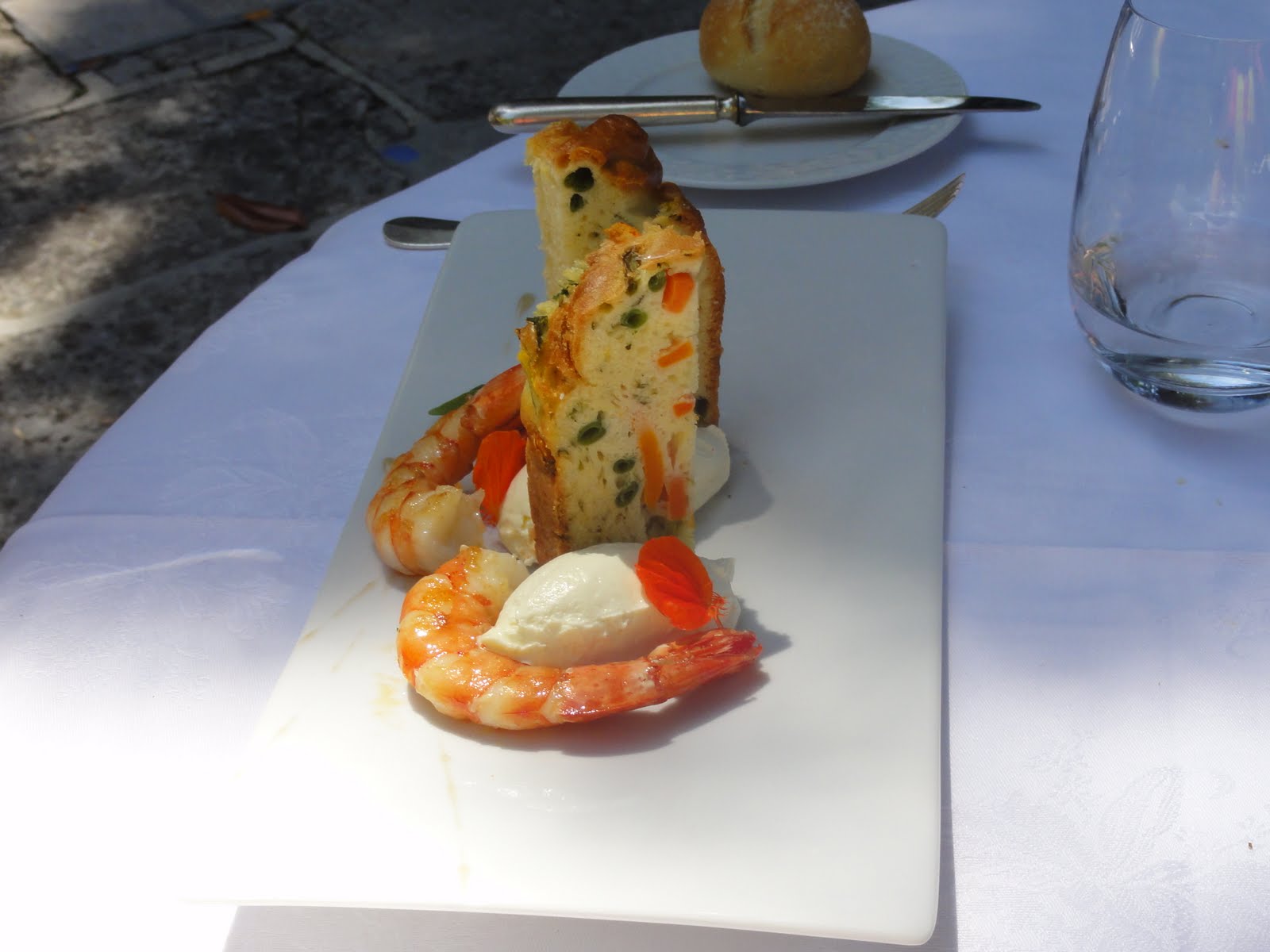
Vegetable cake with prawns


Mains

Desserts


Ended with the most unusual method Ive ever seen to remove bread crumbs from the table- the waiter took a spoon and sweeped it in a figure of eight movement to pick up the crumbs. We experimented doing this ourselves over the next few days but found it impossible!!
Other than The Fat Duck in Bray- one of the most enjoyable dining experiences of my life!
Definately the town...and the restaurant...are worthy inclusions in the 1000 places to see before you die  book.

Monday, 27 June 2011

193: The Great Walll of China

There have been a few things I have seen on tv and thought…. “Cor blimey that looks cool. Have to try that.” And the luge is one of those. Racing at speeds up to 140 km/hour with a 5 G-force down a shiny tube seems like a heap of fun. And so it was with some surprise that I clocked that the alpines seemed to have been moved to the Great Wall of China- my 193rd place to visit in the 1000 places to see before you die book. The choice of going up to the top of the Great Wall (or indeed down) using a ski lift…or coming down on a toboggan in a shiny steel tube, seemed rather surreal given I was in the sticks of China and there was cherry blossoms in the fields rather than snow.

Suffice to say, after climbing the Great Wall, I mounted one of these black, tiny sleds with a rudimentary brake in the centre and wound my way down some rather steep bends. I was half expecting to pass under giant golden arches and have vouchers for McDonald’s given to me by the guards monitoring the speed on the tube.  At the least however, upgrading to the luge as my new adventure sport seems not to be my forte given some rude tourist in the ski lift above my head screamed out “use the accelerator” at one point.
Anyhow, to the Wall. An ongoing engineering feat that started from the 5th century BC and continued to the 16th century to protect China from those Mongol Huns. It is rather a sad state of affairs to think the first Emperor of China, Qin Shi Huang (who also commissioned the Terracotta Warriors) left such treasures for subsequent civilisations….whereas the last Emperor of China, poor Puyi, left to the world a few gardening gloves.
Anyhow, a bit like the broken warriors, not much of the Wall that Huang built remains, the majority remaining is from the Ming Dynasty. It roughly stretches from the sea all the way along the northern edge of China for some 6,200 km- in fact given natural barriers such as rivers and a few trenches- it hits 8,851 km. It sad to think that a good portion of the Wall has gone- removed for expansion, graffitied, covered by sandstorms, or used as a source of building materials.

Over a million workers died building the wall and you can see why given that each stone was over 2 feet in depth and length and had to be hand cut and lugged up to the top of the very extreme mountain range.
In the end, the Wall proved to be of little deterrent when a Ming border general opened the gates at one section as he was disgruntled with the Chinese rulers. And so the Manchu invasion swept in, overthrew Beijing, defeated the ruling Shun Dynasty, and started their own Qing Dynasty. At that point, the Wall fell into disrepair as there was no need for it. Reminder in life that there is always someone who decides to piss inside the tent!
There is about seven sections of the wall most tourists go to- I went to the Mutianyu section which runs for about 2.25 km, as I was intrigued to see the nearby Ming tombs- two only of which had been excavated.
Now to remove a myth- the Great Wall is not visible from space. This rumour started in the 1700’s but the problem is- local materials were used. So in fact, the Wall is this rather disappointing shabby grey, indistinguishable from the grey soils of the mountains that it sits. It is highly unphotogenic- as most walls are. Given that the widest sections are only 9m wide, it is invisible from space as reported as it would appear about the same width of a human hair viewed from 3.5 miles away…. so the web tells me. It is barely visible- and even then only under perfect conditions- at a height of 160 km …but then so are many other man made objects at this height.


Anyhow, I have walked the Wall and like all tourists who have done so…yes I bought the t-shirt saying so as well!!
Should it be in the 1000 places to see before you die book. Well its not much to look at, its a bit of a schlepp to get there, but given that there will never be a wall built like this in history again....yes!


Sunday, 19 June 2011

192: Imperial Palace, Beijing

Yes, yes, yes…loved it so much I went back twice!! Why wouldn’t you when next year the Chinese Government are putting restrictions on the number of tourists- first 100,000 apparently will get in after that no….and this is a place that in peak season has 150,000 tourists a day.


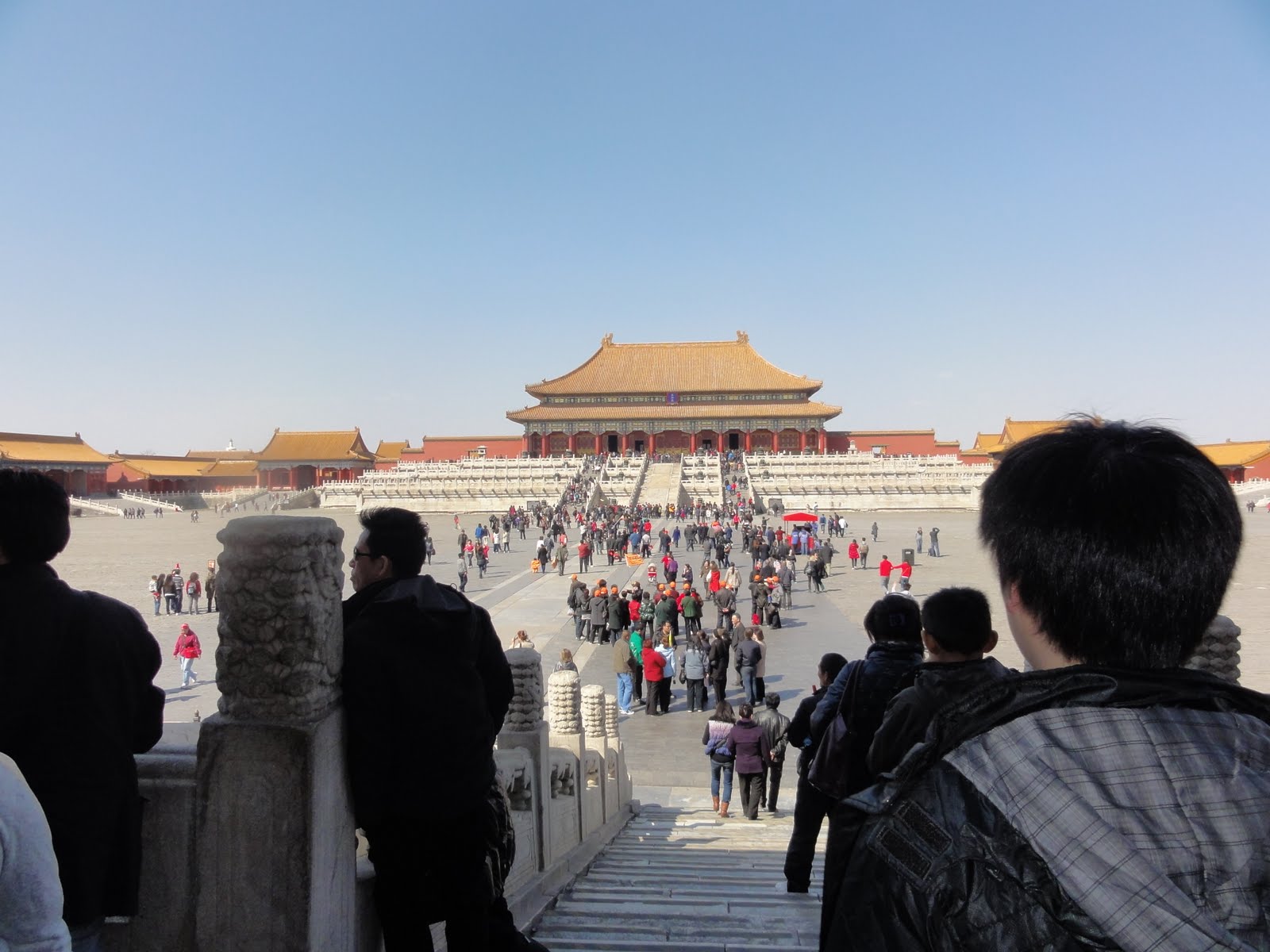
My first thoughts was to rush through all the various palaces to get to that massive courtyard that has been used…largely as a simulated backdrop…in a number of movies. But…Id purchased an electronic tour guide thing so off I set.

And, being China…what fun the electronic gadget was. It had a map with little coloured buttons that showed you where you were, blinked on suggested routes, automatically changed if you decided to skip somewhere to a new section – there must be a little GPS transmitter in there. No wonder they asked for a hefty, by Chinese standards, deposit when you rented one. Absolutely fabulous!


The Forbidden City, also called the Palace Museum is up there in my mind with Versailles, Buckingham Palace and the Kremlin. A UNESCO World Cultural Heritage Building and the largest collection of preserved ancient wooden structures in the world, it was built in the Ming Dynasty (1368-1644).


Such was the labour force of the Emperor at the time that it took over one million workers a mere fourteen years from 1406 to 1420 to build some 8700 rooms in 980 buildings spread over 720,000 m2. It is colossal. Twenty-four emperors, their wives, concubines, eunuchs and related staff lived there and it also served as the ceremonial and political center of the Chinese government.

It is called Forbidden City¸ as no one could arrive or leave without the Emperor’s permission. Trapped there in gilded splendour for the rest of their lives if they entered the palace to join the court. The museums now inside it were a treasure trove of the intrigue at palace life…It was kind of eerie standing in the large courtyard and remembering that scene in The Last Emperor of all the eunuchs being banned and leaving carrying their private parts in pots after burning down the storehouses.


The simplicity on one hand of the design- Asian- and the grandeur of the yellow tiles, red lacquer, gold leaf and dark screened wood, created a scene of extreme opulence. The only thing Id complain about would be if you were to marry an emperor- the beds in the honeymoon area where the newlyweds stayed for two weeks did not look comfortable! But then I doubt they were both 6 foot Caucasian heifers!!


As well as the incredible beauty of the buildings, the palace complex houses over a million rare treasures dotted in the palaces- holding paintings, clocks, bronze wares, pottery, jade and jewellery.

The guide was excellent- explaining all of the various halls as I lost a few hours ambling around the complex. The names of them all were very evocative- the Halls of Supreme Harmony, Central Harmony and Preserving Harmony, Heavenly Purity, Earth Tranquility, Mental Cultivation, Joyful Longevity, Ancestral Worship and Union and Peace.


The palace, after being a place of birth and death for the Emperors, ceased to be the political centre of China in 1912 when the Last Emperor- Puyi abdicated (amazing film if you haven’t seen it- he ascended at the tender age of a little under 3 years old in December 1908). He was allowed to remain in the Inner Court, while the Outer Court was used by the public, but was evicted after a coup in 1924.


The Emperor resided in the Palace of Heavenly Purity- which represented yang and the heavens. The Empress meanwhile received in the Palace of Earthly Tranquility, representing yin and the earth. Between these two palaces, lay the Hall of Union, representing where yin and yang mixed to produce harmony.

The famous Nine Dragons Screen in front of the Palace of Tranquil Longevity, replete with one damaged tile that various rumours abound!


The palace is a stunning masterpiece now enjoyed by millions of people each year rather than the few thousand in the privileged emperor’s courts of the time. Slightly more for people to visit here than what the last emperor left future generations- a few gardening gloves!

However the highlight of the tour was definately the below....


Dying of hunger I entered what seemed to be the only place in the entire complex selling food or drink. It was like a little store with three shelves of food. I pointed at the above as Id seen some people eating it outside and it looked like a hot chicken noodle dish. Walking outside with my little yellow plastic container I opened it to find this rather congealed mess inside which was, to say the least, rather unpalatable. A chinese then came up to me and closed the lid of my container and motioned on his watch the second hand going around 3 times. So I sat and a minute later this little amazing thin plastic container started to shake. Next thing you know hot steam was pouring out of the little hole on the lid and the whole thing was hissing. After the alloted 3 minutes I opened the container and hey presto....hot chicken noodle dish! Amazing- it seemed to have a hidden layer in the bottom which somehow the staff had activated when I purchased it. Great idea!


w